13 Questions to Ask When Buying a Used RV (Before You Hand Over a Dime)

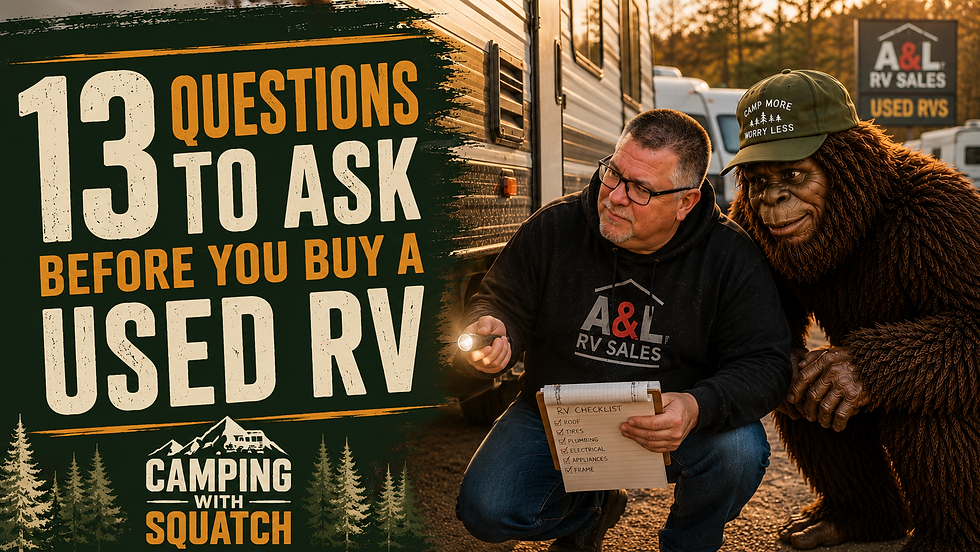
I'll be straight with you: the first used camper I ever got excited about had a soft spot in the floor I could've stepped right through if I'd put my boot down wrong. It looked gorgeous. Shiny outside, smelled fine, owner was nice as could be. And it was hiding about four grand of water damage under a throw rug that was placed there — and I cannot prove this in a court of law — suspiciously on purpose.
That camper taught me more than any sales class ever did. So here's the deal: you're the one making this call, and a used RV can be one of the smartest buys out there if you know what to ask before you fall in love with the curtains. My job is just to hand you the questions that get the truth out into the open. Bring these with you, ask every single one, and watch how fast a seller's story either holds up or falls apart.
Let's get into it.
The Questions to Ask When Buying a Used RV (Grouped So You Don't Miss One)
Before we dig in, here's the lay of the land. I've sorted the questions to ask when buying a used RV into five buckets — history, water damage, systems, tires and towing, and one honest gut-check for yourself. Work through them in that order and you'll catch the stuff that sinks most first-time buyers.
Questions About the RV's History
Start here, because the past tells you almost everything about the future.
Why are you selling it? Listen to the whole answer, not just the first sentence. "Upgrading to a bigger fifth wheel" is a great answer. "Just never really used it" on a unit with 40,000 miles of wear is a story that doesn't add up.
How was it stored — covered, indoors, or out in the weather? Sun and standing water are an RV's two worst enemies. A rig that lived under a carport will almost always be in better shape than one that baked in a field for six years.
Do you have the maintenance records? Roof resealing, wheel bearing repacks, appliance service — a seller who kept records is a seller who took care of the thing. No records isn't an automatic no, but it changes how hard you inspect everything else.
Has it ever had water damage or leaks? Ask it plainly and watch their face. Then go verify it yourself anyway (more on that below).
The Water Damage Questions (This Is the Big One)
Water is what kills campers. Not mileage, not age — water. Spend most of your inspection time here.
When was the roof last resealed, and can I get up there to look? A good seller will say yes. Up top, you're looking for cracked or peeling sealant around vents, the AC unit, and seams.
Can I check the soft spots myself? Press around windows, the bathroom, slide-outs, and any corner. The floor and walls should feel firm. Spongy, soft, or "bouncy" means water has already gotten in and started rotting the structure.
What's that smell? Trust your nose. A musty, damp, "old basement" smell is mold and moisture talking, even when everything looks dry. If they've got every window open and three air fresheners going, ask yourself why.
For the full water-damage walkthrough, I broke it all down in my New vs. Used RV guide — worth a read before you go look at anything.
Questions About the Systems
This is where a camper either works like a tiny house on wheels or becomes a very expensive lawn ornament.
Can we test every appliance, right now, together? Fridge (on both propane and electric), furnace, water heater, AC, stove, microwave. Don't take "it all works" for an answer — make them prove it. A fridge that won't cool on propane is a common and pricey fix.
Can I see the electrical system run? Plug it in. Check that outlets, lights, the converter, and the breaker panel all behave. If there's a battery, ask its age — most last 3–6 years and replacements add up. (I cover what to look for in my RV Batteries Explained post.)
Does the plumbing hold water and drain clean? Run the faucets, flush the toilet, check under sinks for leaks. Ask when the holding tanks were last flushed and whether they drain properly — a neglected black tank is no fun for anybody. (Here's my RV Holding Tanks Explained guide if that's new to you.)
Questions About Tires, Chassis, and Towing
10,000 pounds rolling down I-24 is no place to discover a problem.
How old are the tires? RV tires age out before they wear out. Check the DOT date stamp on the sidewall — anything over 5–6 years should be on your replacement radar regardless of tread, and that's a cost to factor into your offer.
What's the dry weight, and will my truck actually tow it? Match the camper's loaded weight against your tow vehicle's real numbers, not what you hope they are. Bringing the wrong tow setup home is a heartbreaker.
The Question to Ask Yourself
Does this camper fit the way I actually camp — or the way I'm imagining I'll camp? Be honest. The bunkhouse you don't need, the outdoor kitchen you'll use twice, the length your favorite campground won't allow. The best used RV is the one that fits your real life, not the brochure version of it.
Squatch Tips
Bring a flashlight, a notepad, and your phone. Photograph everything — especially the roof, the corners, and the tag with the weights and VIN. You'll want them later.
Go on a dry, sunny day if you can. Sneaky leaks hide better when it hasn't rained in a week. A camper that's been through a recent storm tells you more.
Never inspect and buy in the same hour. Sleep on it. A seller who pressures you to decide right now is a seller telling you something.
Get it weighed if you're serious. A nearby truck scale costs about ten bucks and settles the towing question for good.
If they won't let you test it plugged in and running, walk away. Full stop. There's always another camper.
Your Printable Pre-Purchase Checklist
Take this with you. Print it, screenshot it, whatever gets it in your pocket on inspection day:
[ ] Asked why they're really selling
[ ] Confirmed how it was stored
[ ] Reviewed maintenance records
[ ] Climbed up and checked the roof + sealant
[ ] Pressed for soft spots (floor, walls, corners, slides)
[ ] Sniff test for mold/moisture
[ ] Tested fridge on propane AND electric
[ ] Ran furnace, AC, water heater, stove, microwave
[ ] Checked electrical, outlets, converter, battery age
[ ] Ran plumbing, flushed toilet, checked for leaks
[ ] Read the tire DOT date stamps
[ ] Matched loaded weight to my tow vehicle
[ ] Asked myself if it fits how I actually camp
One Last Thing
Buying used doesn't have to be scary — it just has to be done with your eyes open. Ask the questions, trust your gut, and don't let anybody rush you. And if you're shopping around Middle Tennessee and want a second set of eyes — or you just want to talk through whether a unit's a good fit before you drive out to see it — call or text me directly at 615-653-7561. I'd rather help you ask the right questions than sell you the wrong camper.
Happy hunting. Watch for those throw rugs.
— Squatch 🦶


Comments