5th Wheels Explained: The Roomiest, Most Home-Like Towable

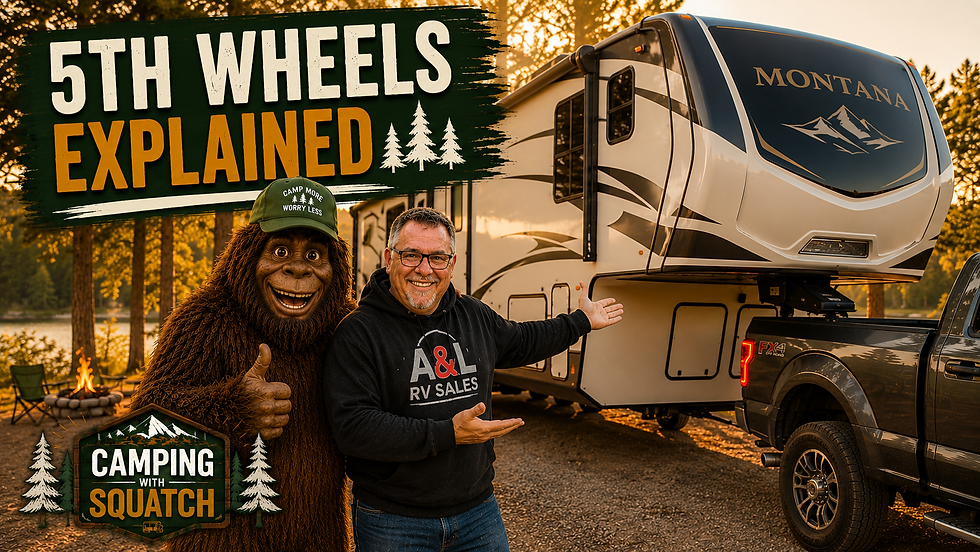
If you've ever walked into a 5th wheel at an RV show and thought "wait, this feels like an actual apartment" — yeah, that's kind of the whole idea. The 5th wheel is the roomiest, most residential towable out there, and it's a favorite of full-timers and big families for good reason. But it also asks more of you (namely, a serious truck), so let's dig into whether it's the right rig for the way you camp.
I'm Joe — Squatch to most folks — and this is the next deep-dive in my series on the [different types of RVs]. If travel trailers are where a lot of folks start, 5th wheels are where a lot of folks end up when they want more room. Let's get into what makes them special — and where they'll cost you.
What Is a 5th Wheel?
A 5th wheel is a towable RV that hitches into the bed of a pickup truck — not to a ball on the bumper like a travel trailer, but to a special hitch mounted in the truck bed, connected by a kingpin. That front section of the trailer extends up and over the truck bed, giving you that signature raised nose.
That raised front is the secret to the whole design: it creates a bi-level floor plan. You walk up a few steps into the front section — usually a spacious bedroom or a living area — which is how 5th wheels pack so much room and that "real home" feel into their length. The tradeoff, right up front so you know it: you must have a pickup truck to tow one. No SUVs, no vans, no exceptions.
Who a 5th Wheel Is Best For
5th wheels shine for:
Full-timers who want a real, livable home on wheels.
Families who need serious space, storage, and sometimes a second bathroom.
Frequent and long-trip campers who practically live in their rig on the road.
Folks who already own (or will buy) a capable pickup truck.
Anyone who prioritizes a roomy, residential feel over towing with a smaller vehicle.
The Pros (Why People Love Them)
The most living space and residential feel of any towable. That bi-level design gives you tall ceilings, big kitchens, real bedrooms, tons of storage, and often multiple slide-outs. It genuinely feels like a small apartment.
Rock-solid, stable towing. Because the hitch sits over the truck's rear axle (right in the bed) instead of way back at the bumper, a 5th wheel tows more stably than a travel trailer — noticeably less sway, and it handles wind and passing semis better. Many folks find them less nerve-wracking to tow despite the size.
Surprisingly maneuverable for the size. That pivot point over the axle lets a 5th wheel turn sharper and back up more intuitively than a long travel trailer. It takes practice, but it's friendlier than you'd expect.
Built for the long haul. Space, storage, and comfort make them a top choice for full-timing and snowbirding.
Your truck's still free at camp. Unhitch and drive off for supplies and exploring, same as any towable.
The Honest Cons (Straight Talk)
You need a pickup — usually a stout one. This is the big one. No truck, no 5th wheel, and the bigger models want a 3/4-ton or 1-ton truck. If you don't own one, factor that truck into your real budget.
The hitch eats your truck bed. That in-bed hitch takes up bed space (though removable and slider options exist), so hauling in the bed gets trickier.
Pin weight is heavy — and it lands on your truck. A big chunk of the trailer's weight presses down in your truck bed, and that counts hard against your truck's payload. This is the number that makes or breaks a safe setup — see my [RV weight ratings] guide, because pin weight trips up a lot of buyers.
Tall and long. Height matters (mind low bridges, clearances, and home storage), and the length can rule out some smaller campsites.
Steps inside. The bi-level layout means climbing a few steps to the front bedroom — minor for most, worth noting if stairs are a challenge.
Pricier overall. They generally cost more than a comparable travel trailer, plus you need the truck to pull it.
What Does a 5th Wheel Cost?
Honest ballpark: 5th wheels span a wide range. A used one can be a solid value entry, while new models commonly run from around $35,000 up past $100,000 for big luxury and full-time rigs. And remember the hidden cost — if you don't already have a capable pickup, that truck is part of the real price of getting into a 5th wheel. Prices move with size, features, and the market, so treat these as ballparks and check current numbers.
You'll Love a 5th Wheel If...
You want the most space and the most residential, home-like feel in a towable
You full-time, snowbird, or camp long and often
You already own — or are happy to buy — a capable pickup truck
You want stable, confident towing for a big rig
Your family needs real room (and maybe that second bathroom)
You Might Skip It If...
You don't have a pickup and don't want to buy one (look at a travel trailer — I compare the two head-to-head in my [5th wheel vs. travel trailer] post)
You want something lighter or towable by an SUV
You mostly camp weekends and don't need all that space
You'd rather just drive and go with no towing (look at a motorhome)
Home storage for something tall and long would be a headache
Squatch Tips: Shopping for a 5th Wheel
Know your truck's PAYLOAD, not just its tow rating. Pin weight lands in your bed and eats payload fast. This is the number that decides whether your truck can safely handle the 5th wheel you want. Check it first.
Get the right in-bed hitch and have it installed properly. Consider a slider hitch if you've got a short-bed truck, for tighter turns.
Know your rig's height. Write it down, put it on a sticker on your dash, and watch those clearances. Tall rigs and low bridges don't mix.
Practice the hitch-up. Coupling in the truck bed is different from a ball hitch — run through it a few times before your first trip.
Consider starting used. A gently used 5th wheel is a great way to get into the space without the steepest price, especially while you learn.
Walk the floor plans in person. Space lives differently than it reads on paper — stand inside a few and picture your real days in it.
That's the heart of Camping with Squatch — making sure you get the right rig and the right truck to pull it, so you're safe and comfortable out there.
Print This: 5th Wheel Shopping Checklist
Take it to the lot.
Before You Shop
[ ] Confirm you have (or will buy) a suitable pickup truck
[ ] Know your truck's payload AND tow rating
[ ] Set a real budget (5th wheel + hitch + truck if needed)
At the Lot
[ ] Floor plan fits how your crew really camps
[ ] Pin weight fits within your truck's payload (with margin)
[ ] Loaded weight is within your truck's limits
[ ] Height and length are manageable to tow, store, and camp with
[ ] New vs. used decision made
Don't Forget
[ ] Proper in-bed hitch (slider if short-bed truck)
[ ] Note your travel height; watch clearances
[ ] Practice hitching before your first trip
The Bottom Line on 5th Wheels
A 5th wheel is the closest thing to bringing your home along that the towable world offers — roomy, stable to tow, and built for serious, comfortable camping. The catch is the commitment: you need a capable pickup, and you're handling a tall, heavy rig. But for full-timers, big families, and anyone who wants that residential feel, it's absolutely worth it. Match it to the right truck, respect the pin weight, and you've got a fantastic home base for years of adventures.
And if you want a hand figuring out whether your truck can handle a 5th wheel — or which one fits your family and your budget — come find me at A&L RV Sales in Christiana, just outside Murfreesboro. Making sure the rig and the truck are a safe, happy match is exactly what I'm here for, no pressure attached. Give me a call or text at 615-653-7561, or follow along with Camping with Squatch for the rest of the RV types series. I just want you in the right rig — and camping happy.


Comments