Can My Vehicle Tow a Camper? How to Know for Sure (Before You Buy)

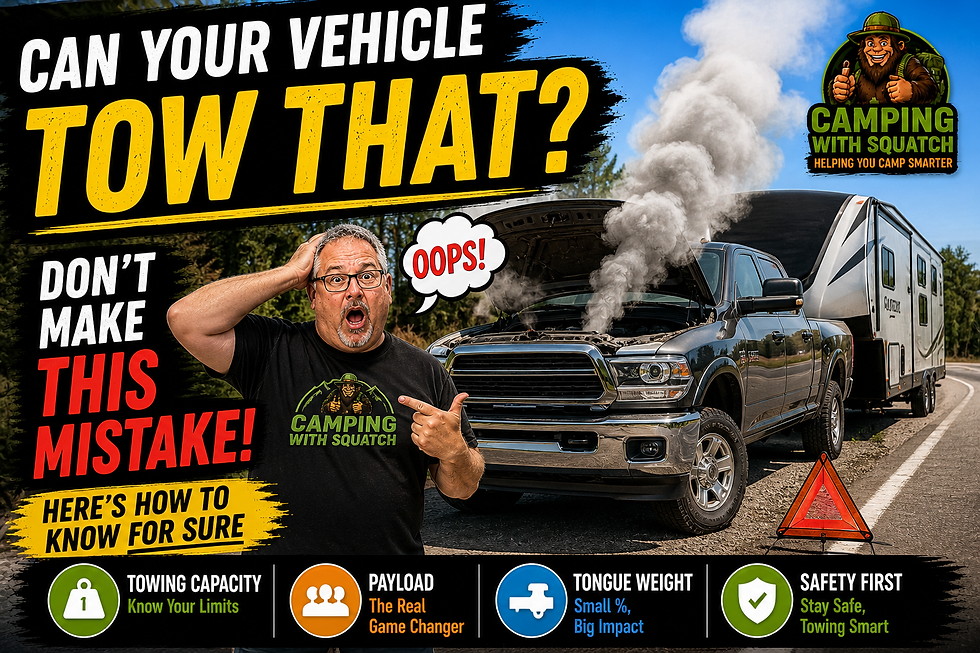
A simple, real-world guide to towing capacity, payload, and choosing the right camper for your vehicle.
Thinking About a Camper? Let’s Talk About Your Tow Vehicle First
Before you fall in love with a camper, you need to answer one question:
Can your vehicle actually tow it?
I see this all the time. Someone finds the perfect RV, gets excited, and then asks if their truck can handle it.
Sometimes the answer is yes. A lot of times… it’s not as simple as it sounds.
What your vehicle can tow on paper and what it can tow safely in real life are two very different things.
Let’s break this down so you can make the right call the first time.
The Biggest Mistake People Make
Most people look at one number:
Maximum tow rating
That’s the big number you see in ads.
The problem is, that number assumes:
No passengers
No cargo
Ideal conditions
That’s not how anyone actually uses their vehicle.
Can My Vehicle Tow a Camper? The Numbers That Actually Matter
If you really want to know if your vehicle can tow a camper, you need to understand these four things.
1. Tow Rating (Starting Point Only)
This is your maximum towing capacity, but it’s just the starting point.
2. Payload Capacity (The Most Important Number)
This is where most people get it wrong.
Payload includes:
You
Your passengers
Anything in the vehicle
The tongue weight of the camper
You can find this number on the sticker inside your driver’s door.
In many cases, payload is the limiting factor—not tow rating.
3. Tongue Weight (What the Camper Adds to Your Vehicle)
Most travel trailers put about:
10% to 15% of their weight on the hitch
Example:
A 6,000 lb. camper = 600 to 900 lbs. of tongue weight
That weight counts directly against your payload.
4. GVWR (Gross Vehicle Weight Rating)
This is the maximum your vehicle can weigh fully loaded:
Vehicle
People
Cargo
Hitch weight
Go over this, and you are overloaded.
Real-World Example (This Is Where It Makes Sense)
Let’s say:
Tow rating: 9,000 lbs.
Payload: 1,500 lbs.
Now load it up:
Two people: 350 lbs.
Gear: 150 lbs.
Tongue weight: 800 lbs.
You’re already at:1,300 lbs. of payload used
That leaves almost nothing left.
So even though your truck says it can tow 9,000 lbs., your real-world limit is much lower.
The 80% Rule (Smart and Safe Towing)
A simple rule I always recommend:
Stay around 70–80% of your max towing capacity
Why it matters:
Better control
Safer braking
Less strain on your vehicle
A much more comfortable drive
Just because your vehicle can tow it doesn’t mean it should.
Other Factors That Matter More Than You Think
A few things that can make or break your towing experience:
Wheelbase (longer is more stable)
Suspension (half-ton vs 3/4 ton)
Proper hitch setup (weight distribution hitch)
Trailer brakes
These don’t always get talked about, but they matter.
So What Camper Should You Be Looking At?
Here’s the simplest way to approach it:
Start with your payload
Estimate tongue weight
Work backwards to find a safe camper size
Most people end up realizing they need something a little smaller than they first thought.
And that’s a good thing.
The right camper is one you can tow confidently, not just technically.
Final Thoughts
This is one of the most important parts of buying a camper.
Get it right, and every trip is enjoyable. Get it wrong, and every mile feels stressful.
Take the time to understand your numbers before you buy.
Need Help Matching Your Vehicle to the Right Camper?
That’s what I do every day.
Bring me:
Your vehicle details
The camper you’re considering
And I’ll help you:
Stay within safe limits
Make a smart decision
Find something that actually works for you
If you’re just getting started, check out my 2 Minute Tours for quick, honest walkthroughs that help you decide fast.


Comments