The True Cost of RV Ownership: What Nobody Tells You Before You Buy

Updated: Oct 7
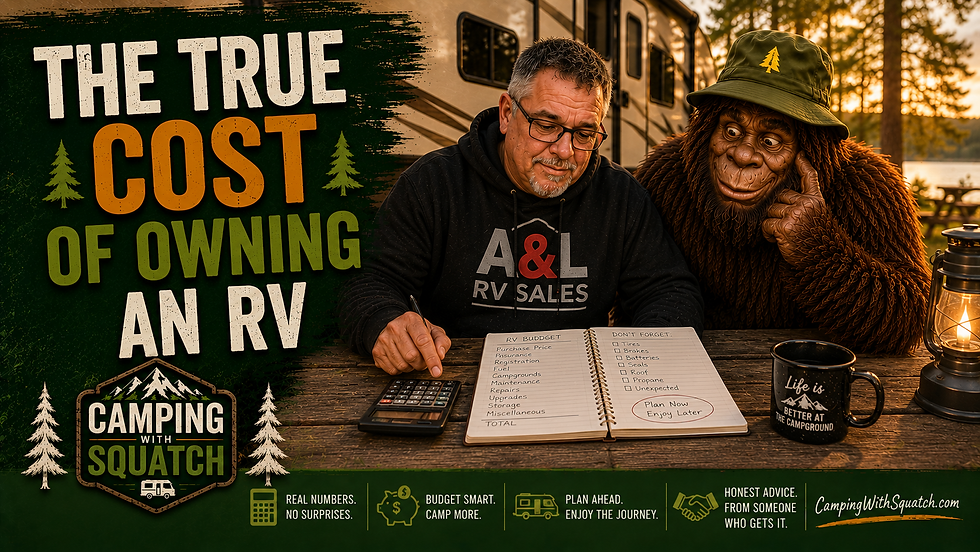
Let me be the guy who tells you the truth, even though I sell these things for a living: the sticker price is only the beginning. The purchase is maybe half of what an RV actually costs you over the years you own it. The other half — insurance, maintenance, storage, campgrounds, fuel, and that sneaky one, depreciation — is the part that blindsides new owners. Every year, thousands of folks end up selling their rigs at a loss within a couple of years simply because nobody laid out the real numbers for them.
I'm Joe — Squatch to most folks — and I'd rather you walk into this with your eyes wide open and your budget ready than have you fall in love with a rig you can't comfortably keep. So let's talk honest money, because understanding the real cost of RV ownership is what keeps this dream fun instead of stressful. This is part of my [RV beginners guide], and it might be the most important one in it.
(Quick note: I'm an RV guy, not a financial advisor, and every one of these numbers swings with your rig, your location, and how you camp. Treat these as ballparks to budget around, not exact quotes.)
The Big One Nobody Wants to Talk About: Depreciation
Here's the cost that isn't a bill you pay — it's value that quietly evaporates. RVs depreciate fast, especially in the first few years. A brand-new rig can lose a big chunk of its value the moment you drive it off the lot, and a new $100,000 RV might be worth somewhere in the $45,000–$60,000 range five years later.
That's not meant to scare you off — it's meant to point you at the single most powerful money-saving move in all of RVing: buy used and let somebody else eat that first-year depreciation hit. A gently used rig that's two or three years old can be a spectacular value, because the previous owner already took the big loss for you. (I dig into this tradeoff in my [new vs. used RV] guide.)
The Ongoing Costs (Budget for These)
Here's the honest rundown of what you'll actually spend year to year. Ballparks for 2026:
Insurance. Varies a lot by rig type and your driving record. Travel trailers are cheapest (often a few hundred dollars a year), Class C motorhomes land in the middle (roughly $500–$1,500), and big Class A coaches run highest ($800–$2,000+). Full-timer policies cost more. Shop it around — rates vary wildly between companies for the exact same coverage.
Maintenance and repairs. The common rule of thumb: budget 1–2% of your rig's value per year for upkeep, and honestly a little more for an older or higher-mileage rig. On a $100,000 motorhome, that's $1,000–$2,000 a year in a good year. The catch is the bad year — a new roof membrane, a slide-out motor, or a transmission issue can run into the thousands. RV shop labor commonly runs $100–$150 an hour, and RV-specific parts aren't cheap.
Storage. Unless you've got room at home, you'll pay to park it — anywhere from about $30 a month for a basic outdoor spot to $400+ for covered or indoor storage in a pricey area. Over a year, that's real money, and storing at home (if you can) is a genuine savings.
Campground fees. The nightly cost of actually using it. Basic public campgrounds might run $20–$50 a night; nicer private resorts with full hookups can be $50–$100+. This adds up fast if you camp often — and it's exactly where memberships and boondocking save you.
Fuel. Hugely variable depending on your rig and how far you roam. A big motorhome is thirsty, and even towing a trailer drops your truck's mileage noticeably. A long trip can mean hundreds of dollars in fuel alone.
The smaller stuff that adds up. Registration and licensing (varies by state and rig weight), propane, campground memberships (Good Sam, Thousand Trails, Passport America — these can pay for themselves), internet/connectivity if you work on the road, and the endless little upgrades and gear every new owner buys in year one.
Don't Forget the Emergency Fund
This is the tip that separates the folks who love RVing from the folks who get burned: keep a dedicated RV emergency fund — somewhere in the $2,000–$5,000 range is a sensible target. A single roadside breakdown or a major repair can easily run $1,500–$3,000, and it always seems to happen at the worst time. Having that cushion turns a trip-ruining disaster into an annoying speed bump. (And if you know the [RV 911 emergency guide] stuff cold, you'll prevent a good chunk of those repairs entirely.)
So What's the Total Cost of RV Ownership?
Add it all up and, depending on the rig and how you camp, all-in annual ownership commonly lands somewhere from around $8,000–$15,000 a year for a travel trailer up to $20,000–$30,000 for a big Class A. That's a wide range on purpose — your actual number depends enormously on your choices.
And that's the real headline: your lifestyle choices matter more than your rig choice. Two people can own the identical camper and spend wildly different amounts based on how often they travel, where they stay, whether they store at home, and whether they buy new or used. You have way more control over this number than you'd think.
How to Keep the Costs Down
The good news — RVing can be as affordable or as pricey as you make it. The biggest levers:
Buy used. Say it with me one more time. It's the single most effective way to slash your total cost, mostly by dodging that first-year depreciation.
Store at home if you possibly can. That's $500–$2,400 a year back in your pocket.
Learn basic maintenance. Winterizing, a hub check, minor fixes — doing the simple stuff yourself saves real money, and a $200 service beats a $2,000 breakdown every time.
Get campground memberships if you travel a lot, and mix in some boondocking. Nightly fees are where budgets quietly bleed out.
Shop your insurance every year. Rates vary 30%+ for identical coverage. Ten minutes of quotes can save you hundreds.
Buy the right size. Bigger isn't always better — a smaller rig costs less across every category: purchase, fuel, insurance, storage, tires, all of it.
Stay longer, drive less. Weekly and monthly campground rates beat nightly ones, and less driving means less fuel and less wear.
Squatch Tips: Budgeting for the Real Cost
Budget the whole picture, not the payment. The monthly loan payment is the smallest honest number. Add insurance, storage, maintenance, and fuel before you decide what you can afford.
Buy used and let someone else take the depreciation. I'll keep saying it because it's the biggest money-saver there is.
Keep a $2,000–$5,000 emergency fund. Non-negotiable. The breakdown isn't an if, it's a when.
Store at home if you can. Free is a great price for a parking spot.
Match the rig to how you'll actually camp. Not the dream trip you'll take once — the real trips you'll take often. That's where your true cost lives.
That's the heart of Camping with Squatch — I'd rather sell you a rig you can happily afford for ten years than one you resent in two.
Print This: RV Budget Worksheet
Fill it in before you buy — knowing beats guessing.
One-Time / Upfront
[ ] Purchase price (new or used?)
[ ] Down payment
[ ] Taxes, registration, licensing
[ ] Initial gear & setup
Every Month/Year (your real ongoing cost)
[ ] Loan payment (if financing)
[ ] Insurance (shopped around?)
[ ] Storage (or free at home?)
[ ] Maintenance fund (1–2% of value/year, minimum)
[ ] Campground fees (nights/year × rate)
[ ] Fuel (trips × distance × your rig's thirst)
[ ] Propane, memberships, internet, upgrades
The Safety Net
[ ] Emergency fund started ($2,000–$5,000)
Gut Check
[ ] Does the ALL-IN number (not just the payment) fit my budget comfortably?
Buy With Your Eyes Open
RV ownership is more expensive than most people expect — but it's also more affordable than a lot of folks fear, if you go in with realistic expectations and a real budget. The purchase price is just the down payment on the adventure; the ongoing costs are the rest of the story. Know them, plan for them, buy used when you can, and match the rig to how you truly camp, and you'll be one of the happy ones who keeps their rig for years instead of selling at a loss.


Comments