What Is an RV Inverter? (And Do You Actually Need One?)

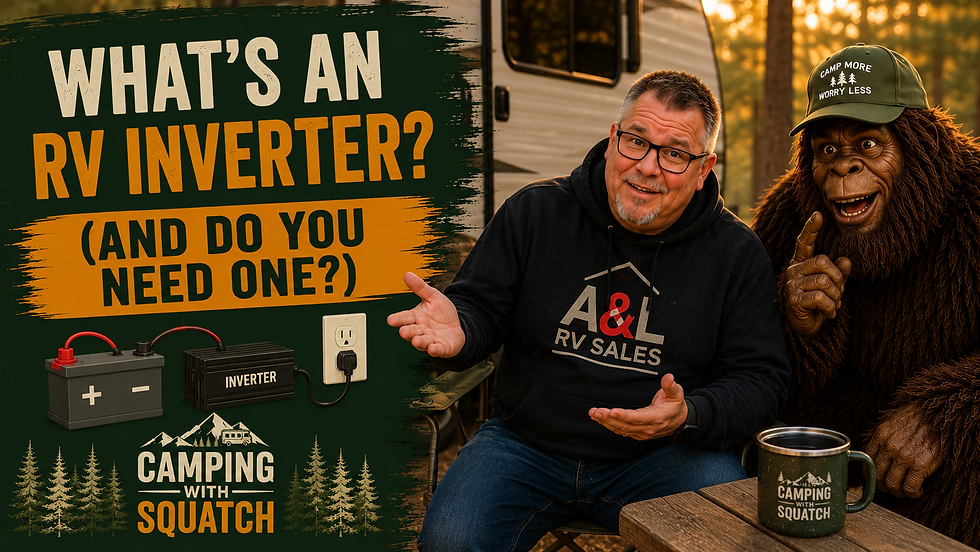
I'll let you in on something I see all the time: a customer asks me about inverters, I start explaining, and I watch their eyes do that polite glaze-over where they're nodding along but secretly have no earthly idea what I'm talking about. And you know what? That's not on them. Nobody ever explained it in plain English. So that's exactly what we're gonna do right here, no shame and no jargon.
I'm Joe — Squatch to most folks — and today on Camping with Squatch we're answering two simple questions: what is an RV inverter, and do you actually need one? By the end you'll understand it well enough to explain it to your buddy who's nodding along pretending. Let's make this click.
The Two Kinds of Power in Your Camper
Stick with me for ten seconds, because this is the whole key to understanding an inverter.
Your camper runs on two different kinds of electricity:
12-volt DC power — this comes from your batteries. It runs your "12-volt stuff": your LED lights, the water pump, the furnace fan, the slide-outs, and the USB ports.
120-volt AC power — this is the same kind of power that comes out of the wall outlets in your house. Your wall outlets in the camper and household-style appliances need this kind.
When you're plugged into shore power at a campground, that 120-volt AC power flows right in and feeds your outlets — easy. But when you're NOT plugged in — boondocking, dry camping, parked out in the boonies — all you've got is your batteries, and they only make 12-volt DC. So how do you run something that needs a wall outlet?
That, my friends, is where the inverter struts in.
So What Is an RV Inverter?
An inverter is a device that takes the 12-volt DC power from your batteries and converts ("inverts") it into the 120-volt AC power your wall outlets and household devices need.
That's the whole job. It's a translator. It lets you run regular household stuff off your batteries when you're not plugged into shore power. No inverter, and your wall outlets are dead the second you unplug from the campground pedestal — even if your batteries are full.
Simple as that. Battery power goes in one side, "wall outlet" power comes out the other.
Wait — Inverter vs. Converter? (The Confusing Part)
Here's the thing that trips up everybody, so let's kill the confusion right now. Your RV has two similar-sounding gadgets that do opposite jobs:
A converter turns 120V AC (shore power) into 12V DC — it charges your batteries and runs your 12-volt stuff while you're plugged in. Almost every RV already has one built in.
An inverter turns 12V DC (battery) into 120V AC — it powers your household outlets when you're not plugged in. Many RVs don't come with one, or only have a small one.
Easy way to remember it: the conVerter fills your batteries; the inVerter empties them to run your TV. Opposite directions. Now you know more than half the lot, I promise.
Do You Actually Need One?
This is the real question, so let's answer it honestly — because not everybody does.
You probably DON'T need an inverter if:
You almost always camp at campgrounds with shore power hookups. When you're plugged in, your outlets already work — the inverter would just sit there.
The only things you run off-grid are 12-volt items (lights, water pump, furnace) and USB charging — those run straight off your batteries, no inverter required.
You probably DO want an inverter if:
You like to boondock or dry camp (no hookups) and still want to use your wall outlets or household devices.
You want to run things like a TV, a laptop charger plugged into the wall, a game console, a coffee maker, or a household-style fridge while off-grid.
Here's the quick gut-check: Do you want to use your regular wall outlets when you're NOT plugged in? If yes, you need an inverter. If you're always plugged in or only use 12-volt things, you can probably skip it.
And if you just need to charge a phone or laptop occasionally, you might get by with a small portable plug-in inverter (the kind that plugs into a 12-volt outlet) instead of a big installed system. Don't let anybody upsell you a giant unit for a small need.
Pure Sine Wave vs. Modified Sine Wave (Pick the Right One)
If you do get an inverter, you'll see these two terms, so here's the plain version:
Pure sine wave — produces clean, smooth power just like your house. Safe for sensitive electronics (laptops, TVs, CPAP machines, anything with a delicate circuit board) and runs motors efficiently. Costs more, worth it for most folks.
Modified sine wave — cheaper, but the power is "rougher." Some sensitive electronics will buzz, run hot, charge oddly, or refuse to work at all. Fine for simple stuff, risky for the good electronics.
My honest take: if you're running anything you care about, get a pure sine wave inverter. The headache it saves is worth the extra cost.
How Big an Inverter Do You Need?
Inverters are sized in watts, and you want one big enough to handle whatever you'll run at the same time:
Small (around 150–400 watts): charging laptops, running a TV, small devices. Often a simple plug-in unit.
Large (1,000–3,000+ watts): running multiple outlets, a microwave, bigger appliances. Usually hardwired into your system.
The big heat-and-motor hogs (microwave, coffee maker, hair dryer) need a big inverter and a beefy battery bank to feed it.
And here's the reality check that matters most: an inverter doesn't make power — it just converts what's in your batteries. Run a big appliance through it and you'll drain your batteries fast. So your inverter and your battery bank have to be matched. (This is why I keep pointing folks to my [RV batteries] and [RV solar] posts — it's all one connected system: solar refills the batteries, the batteries store the power, and the inverter turns it into wall-outlet power.)
Squatch Tips: Inverter Wisdom Made Simple
Here's what I tell folks so they get this right:
Ask yourself the one question: "Do I want my wall outlets to work when I'm NOT plugged in?" That answer tells you whether you need an inverter, full stop.
Don't confuse it with the converter. The converter charges your batteries on shore power (you've already got one). The inverter does the opposite job for off-grid. Two different gadgets.
Go pure sine wave if you're running anything with a sensitive circuit board. The cheap modified ones can make good electronics misbehave.
Match the inverter to your battery bank. A giant inverter with a tiny battery is like a big straw in a small cup — you'll suck it dry in no time.
Start small if your needs are small. A little plug-in inverter for charging devices may be all you need. You don't have to buy a whole-rig system to charge a laptop.
That's the heart of Camping with Squatch — taking the stuff that makes folks nod and pretend, and actually making it make sense, so you spend your money on what you really need.
Print This: "Do I Need an Inverter?" Quick Reference
Tape it inside a cabinet while you figure out your setup.
Runs WITHOUT an inverter (12-volt — straight off the battery)
[ ] LED lights
[ ] Water pump
[ ] Furnace fan (heat from propane)
[ ] Slide-outs & leveling
[ ] USB charging
[ ] Most RV fridges on propane
NEEDS an inverter (120-volt) when you're OFF shore power
[ ] Wall outlets
[ ] TV / game console
[ ] Laptop charger in a wall outlet
[ ] Coffee maker, microwave, blender
[ ] Household-style fridge
[ ] CPAP (if it's a 120V model)
Decision Check
[ ] Always plugged into shore power? → probably DON'T need one
[ ] Only run 12V stuff + USB off-grid? → probably DON'T need one
[ ] Want wall outlets/household devices while boondocking? → YES, get one
[ ] Running sensitive electronics? → choose PURE SINE WAVE
[ ] Match the inverter size to your battery bank
Now You Get It
An inverter isn't complicated once somebody explains it right: it turns your battery power into the kind of power your wall outlets use, so you can run household stuff when you're off the grid. Whether you need one comes down to one honest question — do you want those outlets working when you're not plugged in? Answer that, and you've got your answer.
And if you're shopping for a rig and want somebody to tell you straight whether it's already got an inverter, or what it'd take to add one for the way you camp — come find me at A&L RV Sales in Christiana, just outside Murfreesboro. Give me a call or text at 615-653-7561, or follow along with Camping with Squatch for more plain-English straight talk. No pressure, ever — I just want you camping happy (and powered up).


Comments